
Peptide Telehealth vs Research-Grade: Cost and Access Comparison 2026
Compare peptide telehealth platforms with research-grade reference material on cost, access, prescription requirements, and post-ban landscape.
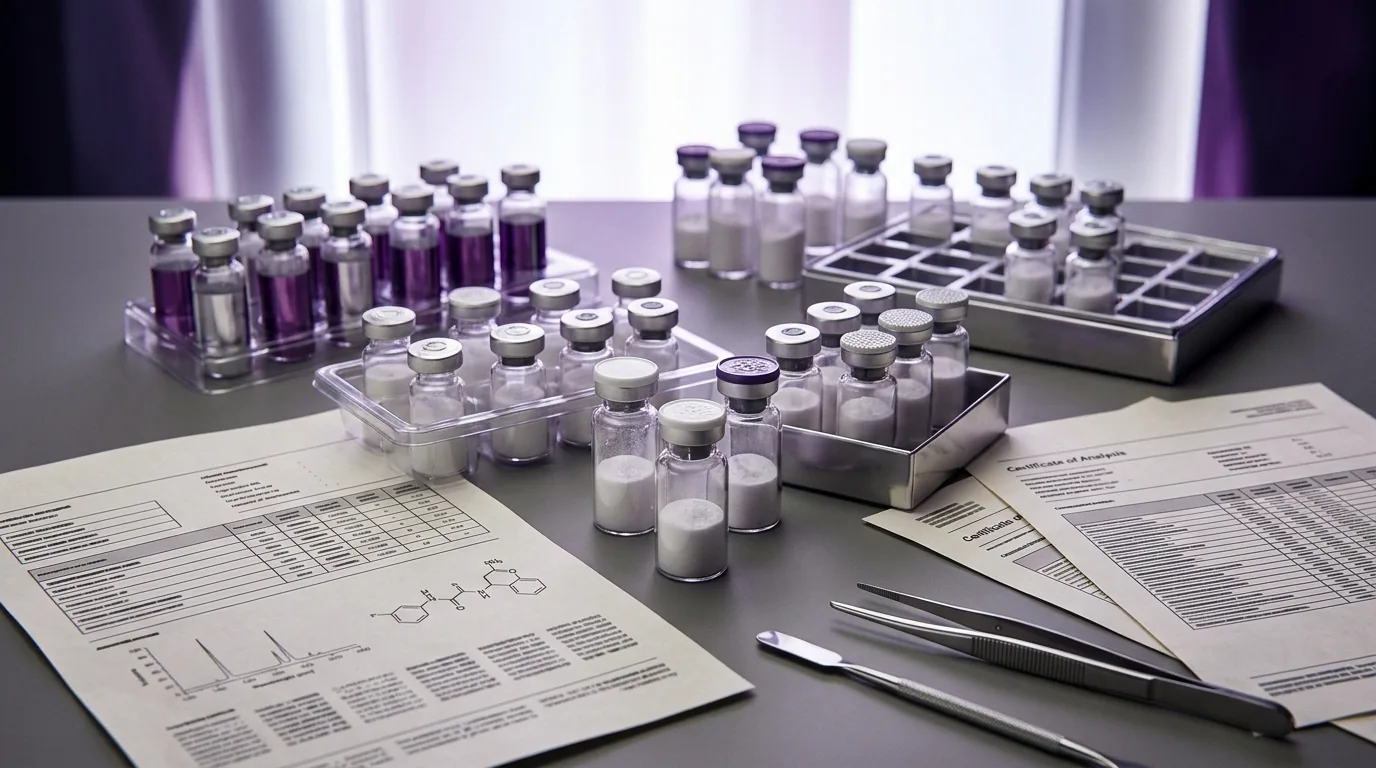
For laboratory research use only. Not for human consumption.
Peptide Telehealth Landscape in 2026
Peptide telehealth in early 2026 is dominated by a small set of multi-state platforms operating direct-to-consumer prescribing models. Henry Meds, Eden, Ro, Hims, and several smaller competitors offer asynchronous or synchronous clinician encounters, after which prescriptions are routed to partner pharmacies. The clinical channel for these platforms in 2026 has shifted decisively toward FDA-approved branded GLP-1 products as compounded options have been removed.
For non-GLP-1 peptides discussed in research literature, telehealth options are far more limited. Most peptides commonly studied in laboratory contexts have no FDA-approved human indication and therefore cannot be prescribed clinically.
Cost Comparison: Telehealth vs Research-Grade
Telehealth GLP-1 access in 2026 typically runs 250 to 600 USD per month for branded products at cash-pay pricing, before manufacturer savings programs. Research-grade reference material for the same molecule may be priced at the equivalent of 25 to 50 USD per month of laboratory work, but this is a chemistry-supply price point, not a healthcare price point.
The price gap between telehealth and research-grade reflects a fundamental difference in product category. Research-grade material is not a clinical product and is not interchangeable with one.
- Telehealth branded GLP-1: 250 to 600 USD per month, prescription, pharmacy dispense
- Telehealth compounded GLP-1: increasingly unavailable in 2026 following enforcement
- Research-grade reference material: chemistry-supply pricing, no prescription, no clinical oversight
- Manufacturer savings programs: significant discounts on branded GLP-1 for eligible patients
Prescription Requirements and Clinical Oversight
Telehealth platforms operate under state medical board jurisdiction and require a clinician encounter sufficient to establish a doctor-patient relationship. Prescriptions are individualized and dispensing pharmacies must be licensed in the destination state. This produces accountable clinical oversight, including dose titration, side-effect monitoring, and drug interaction review.
Research-grade reference material has no clinical oversight by design. Researchers are expected to operate within institutional review and laboratory safety frameworks. The two channels exist for entirely different purposes.
Where Telehealth Ingredients Actually Come From
For branded GLP-1 prescribing in 2026, the ingredient supply chain runs from the originator manufacturer through licensed wholesalers to dispensing pharmacies. This chain is well documented and subject to FDA oversight, DSCSA traceability requirements, and state pharmacy regulation.
For the legacy compounded telehealth model, the supply chain frequently traced back to FDA-registered API manufacturers via 503A or 503B compounders. With compounded GLP-1 increasingly off-limits, this pathway is closing as a high-volume consumer-facing channel.
How the Compounding Ban Has Reshaped the Market
The post-shortage enforcement push has bifurcated the market. On one side, compliant telehealth platforms have raised prices to reflect branded acquisition costs and have shifted marketing toward eligibility for manufacturer programs. On the other side, gray-market and offshore offerings have grown, often advertising compounded or unbranded GLP-1 product to former compounded patients.
This second category presents significant risk: opaque sourcing, no verified pharmacy oversight, and frequent COA absence. Researchers and laypeople alike should treat such offerings with skepticism.
Research-Grade as a Laboratory Use Channel
Research-grade reference material is, and has always been, a laboratory chemistry channel. ChemVerify exists to audit this channel: COA quality, vendor identity, batch traceability, synthesis transparency. The channel has legitimate purpose for in vitro experiments, animal model research, assay development, and reference standard work.
It is not a substitute for medical care, and ChemVerify does not present it as one. Researchers procuring through this channel must be operating within an appropriate institutional research framework.
Regulatory Disclaimers Buyers Should Read
- Research-use-only material is not approved for human or veterinary use
- No claims of safety, efficacy, or therapeutic equivalence apply to research-grade peptides
- Diversion of research-grade material to human use is unlawful and unsafe
- Telehealth prescribing is governed by state medical board rules; verify clinician licensure
- Manufacturer savings programs may reduce out-of-pocket costs for eligible patients on branded products
Choosing the Right Channel for Your Use Case
For clinical care, the appropriate channel is a licensed clinician and a licensed pharmacy, with telehealth as a legitimate access mode for branded therapies. For laboratory research, the appropriate channel is a verified research-grade vendor with full COA and traceability. The two channels do not substitute for one another, and conflating them is the most common reasoning error ChemVerify sees in the post-ban market.
If your use case involves a human body, the answer is licensed clinical care. If your use case involves a laboratory experiment, the answer is verified research-grade reference material.
References
Further Reading on ChemVerify
- Read more: Ozempic vs Wegovy: Same Drug, Different Indications Explained 2026 → https://www.chemverify.com/learn/ozempic-vs-wegovy-same-drug-different-2026
- Read more: Best Peptides for Fat Loss 2026: Evidence-Based Rankings → https://www.chemverify.com/learn/best-peptides-for-fat-loss-2026-evidence-rankings
- Read more: Compounded GLP-1 Ban 2026: What's Still Legally Available → https://www.chemverify.com/learn/compounded-glp-1-ban-2026-what-still-available
- Read more: Cheapest Verified Peptide Vendors: Live Price Comparison 2026 → https://www.chemverify.com/learn/cheapest-verified-peptide-vendors-2026-comparison
References
Compare Verified Vendors
Browse COA-verified suppliers with exclusive discount codes and transparent pricing.
Continue Reading
Compounded GLP-1 Ban 2026: What's Still Legally Available
FDA enforcement against compounded semaglutide and tirzepatide is escalating in 2026. Understand 503A/503B, alternatives, and research-grade reality.
Cheapest Verified Peptide Vendors: Live Price Comparison 2026
Compare live peptide prices across nine ChemVerify verified vendors. See price-per-mg, hidden costs, bulk discounts, and FX impacts.
Ozempic vs Wegovy: Same Drug, Different Indications Explained 2026
Ozempic and Wegovy are chemically identical semaglutide. Differences are dose, indication, label, and price. 2026 supply, insurance, oral semaglutide launch.
Best Peptides for Fat Loss 2026: Evidence-Based Rankings
Top 10 fat-loss peptides ranked by 2026 clinical evidence: tirzepatide, semaglutide, retatrutide, cagrilintide, AOD-9604, CJC/Ipa, MOTS-c, more.